
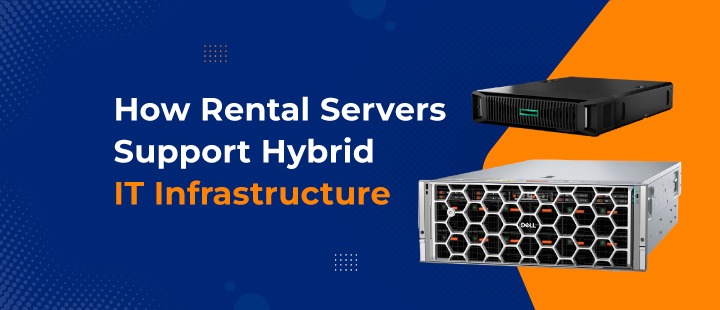
How Rental Servers Support Hybrid IT Infrastructure
Businesses are continuously modernizing their IT environments to support digital transformation, cloud adoption, remote operations, and growing data requirements. Traditional infrastructure alone is no longer enough to handle dynamic workloads and changing business demands. This has increased the adoption of hybrid IT infrastructure, where organizations combine on-premise systems, cloud platforms, and external infrastructure resources for greater flexibility and operational efficiency.
One of the most effective ways businesses are strengthening hybrid IT environments is through Server on Rent solutions. Rental server services provide organizations with scalable and high-performance infrastructure without requiring heavy capital investment. These solutions help businesses quickly expand computing capacity, support temporary workloads, and improve operational agility while optimizing IT costs.
Hybrid IT infrastructure allows organizations to distribute workloads across multiple environments depending on security, performance, and operational requirements. Some applications continue running on private infrastructure for compliance reasons, while others operate in cloud environments for scalability. Server rental solutions act as a bridge between these environments by providing flexible infrastructure whenever additional computing resources are required.
One of the biggest advantages of Server on Rent services is scalability. Business workloads are rarely constant. Companies often experience seasonal traffic spikes, temporary project requirements, software testing demands, or sudden increases in processing needs. Purchasing new hardware for short-term usage can be expensive and inefficient. Rental servers allow businesses to scale infrastructure up or down based on operational requirements without making permanent investments.
Speed is another major reason business prefer rental server solutions. Setting up new in-house infrastructure can take weeks due to procurement, installation, and configuration processes. With dedicated server rental, businesses can deploy enterprise-grade infrastructure quickly and respond faster to operational changes and project demands.
This rapid deployment capability is especially valuable for:
- Software testing environments
- Temporary business projects
- Corporate events
- Data migration activities
- Backup infrastructure
- High-performance computing requirements
Cost optimization is another important factor driving the demand for Server on Rent services. Building and maintaining a large IT infrastructure requires substantial investment in hardware, cooling systems, power, maintenance, and IT management. Rental server solutions reduce this financial burden by providing enterprise-level infrastructure through a flexible operational expense model.
Businesses benefit from:
- Lower upfront investment
- Predictable monthly costs
- Reduced maintenance expenses
- Better budget management
- Flexible infrastructure scaling
Modern hybrid IT environments often involve balancing workloads between cloud platforms and physical infrastructure. Enterprise server rental solutions help organizations extend their IT capacity without overloading internal systems. Businesses can use rental servers for:
- Hybrid cloud integration
- Data backup and disaster recovery
- Temporary application hosting
- Virtualization environments
- Database management
- AI and analytics workloads
This creates a more balanced and efficient IT ecosystem.
Business continuity and disaster recovery have become critical priorities for modern enterprises. Unexpected downtime, cyber threats, or hardware failures can severely impact operations. Server on Rent solutions provide businesses with reliable backup infrastructure and disaster recovery support without requiring permanent investment in additional hardware.
Organizations can quickly deploy rental servers for emergency workloads and maintain uninterrupted business operations during critical situations.
Another major advantage of rental server infrastructure is flexibility for temporary projects. Many organizations require servers only for short durations, such as:
- Product development
- Application testing
- Corporate training
- Event management
- Temporary workload expansion
Purchasing dedicated hardware for short-term use is often impractical. Rental servers offer businesses a cost-effective and scalable alternative.
Businesses managing AI applications, virtualization, big data analytics, and enterprise applications often require high-performance computing environments. Dedicated Server Rental providers offer advanced configurations with powerful processors, GPU support, large RAM capacities, and enterprise-grade storage systems.
This allows businesses to access high-performance infrastructure without long-term ownership commitments.
Many Server on Rent providers also offer installation, maintenance, monitoring, and technical support services. This reduces infrastructure management complexity and helps internal IT teams focus more on strategic business operations instead of hardware management.
Industries such as IT, healthcare, banking, education, manufacturing, e-commerce, and media are increasingly adopting Server Rental Solutions to support hybrid IT infrastructure. Whether it is for cloud integration, temporary projects, business continuity, or scalable computing, rental servers have become an important part of modern enterprise IT strategies.
As digital transformation continues across industries, businesses are looking for more agile and scalable infrastructure models. Server on Rent services provide the flexibility, performance, and cost efficiency required to support modern hybrid IT environments effectively.
By combining cloud platforms, on-premise infrastructure, and rental server solutions, organizations can build a future-ready IT ecosystem capable of supporting long-term business growth, operational efficiency, and digital innovation.