
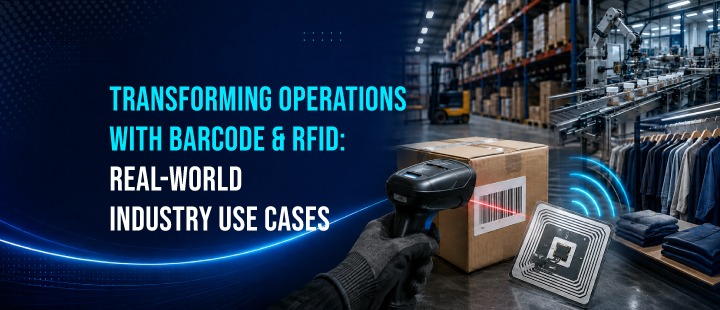
Transforming Operations with Barcode & RFID: Real-World Industry Use Cases
Businesses today need accurate visibility into their inventory, assets, materials, and products. Yet many organizations still depend on manual entries, spreadsheets, and physical stock checks, which can lead to errors, delays, and limited traceability.
Barcode and RFID solutions help bridge this gap by giving every product, asset, carton, pallet, or piece of equipment a unique digital identity.
How Barcode & RFID Improve Operations
Barcode solutions are ideal for cost-effective item-level identification and scanning. RFID goes a step further by allowing items to be detected without direct line-of-sight and, in many applications, multiple tags can be read simultaneously.
Businesses commonly use these technologies for:
- Inventory and warehouse management
- Asset tracking
- Manufacturing and Work-in-Progress tracking
- Picking, packing, and dispatch
- Retail stock management
- Logistics and shipment tracking
- Tool and equipment management
Real-World Example: Zara’s RFID-Based Inventory Management
A strong real-world example comes from Zara, part of the Inditex Group.
Inditex implemented RFID technology to individually identify garments from its logistics operations through to the point of sale. Store teams could use the system to quickly check where products were available and improve replenishment.
Inditex reported that RFID made inventories and stock-taking 80% faster and reduced the time needed for replenishment-related activities.
This shows that RFID is not simply about replacing a barcode scanner. It can provide greater visibility into where inventory is located and help businesses respond faster.
Where Can Businesses Apply the Same Concept?
Warehouse Management
Barcodes can be assigned to products, cartons, pallets, racks, and storage locations.
By scanning during:
Receiving → Put-away → Picking → Packing → Dispatch
businesses can maintain more accurate inventory records and reduce picking or dispatch errors.
For high-volume warehouses, RFID can automate the identification of tagged materials moving through predefined checkpoints.
Manufacturing
Barcode or RFID tags can track materials through each production stage:
Raw Material → Production → Quality Check → Packing → Finished Goods
This provides better visibility into Work-in-Progress and helps identify production bottlenecks.
Asset Tracking
Organizations can tag laptops, printers, servers, tools, machinery, and other equipment.
The system can record:
- Asset location
- Assigned employee
- Department
- Movement history
- Maintenance information
- Current status
This makes physical asset verification faster and improves accountability.
Barcode or RFID: Which Is Right?
Barcode is ideal when you need a simple, affordable solution for individual scanning and identification.
RFID is better suited when you need faster bulk identification, automated tracking, or situations where line-of-sight scanning is difficult.
Many organizations also use a combination of Barcode and RFID depending on the business process.
More Than Hardware
A successful Barcode or RFID project is not just about buying scanners or readers.
A complete solution can include:
- Barcode and RFID labels
- Barcode printers
- Handheld scanners and mobile computers
- RFID readers and antennas
- Asset or inventory management software
- ERP/WMS integration
- Customized applications
- Reporting and analytics
The objective is to connect the physical movement of products and assets with business systems in real time.
Looking to Automate Inventory, Assets or Material Tracking?
We help organizations evaluate and implement end-to-end Barcode, RFID, Asset Tracking, Warehouse Automation and Automatic Identification solutions.
From process assessment and technology selection to hardware, tagging, software integration and deployment, the right solution should be designed around one objective:
Identify accurately. Track automatically. Operate intelligently.