
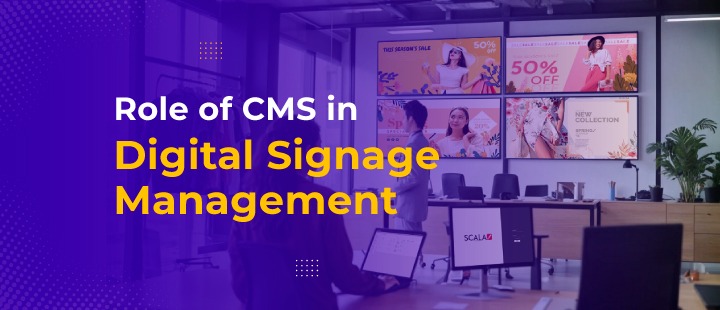
Role of CMS in Digital Signage Management
Digital signage has become an essential communication tool for businesses across industries. From corporate offices and retail stores to banks, hospitals, airports, and educational institutions, organizations are increasingly adopting digital signage solutions to deliver engaging and real-time content.
However, managing content across multiple displays and locations can become challenging without the right system in place. This is where a Content Management System (CMS) plays a critical role in digital signage management.
A digital signage CMS helps businesses centrally control, schedule, update, and monitor content displayed across screens from a single platform. Whether it is one display or thousands of screens spread across multiple locations, CMS software simplifies the entire digital signage operation.
What is a Digital Signage CMS?
A Content Management System (CMS) for digital signage is a software platform used to manage and control content displayed on digital screens. It allows businesses to upload, schedule, organize, and distribute multimedia content such as:
- Images
- Videos
- Announcements
- Advertisements
- Promotional banners
- Real-time information
The CMS acts as the backbone of a digital signage network, enabling centralized management and seamless content distribution.
Importance of CMS in Digital Signage Management
Centralized Content Control
One of the biggest advantages of a digital signage CMS is centralized management. Businesses can control multiple displays across different locations from a single dashboard.
For example, organizations with branches across multiple cities can instantly update promotional content, announcements, or corporate communication without physically visiting each location.
This is especially beneficial for:
- Retail chains
- Banks
- Corporate offices
- Hospitality businesses
- Healthcare networks
Real-Time Content Updates
A CMS allows businesses to update content in real time. This ensures that important information, promotions, or announcements are always current and relevant.
Organizations can instantly:
- Change promotional campaigns
- Display emergency notifications
- Update pricing or offers
- Share event information
- Broadcast live updates
Real-time content management improves communication efficiency and customer engagement.
Content Scheduling and Automation
Modern CMS platforms allow businesses to schedule content based on:
- Time
- Date
- Location
- Audience requirements
For example:
- Retail stores can display promotional offers during peak shopping hours
- Corporate offices can show internal announcements during working hours
- Restaurants can automatically switch menus during breakfast, lunch, and dinner timings
This automation reduces manual effort and ensures consistent content delivery.
Improved Brand Consistency
For organizations operating across multiple branches or franchises, maintaining brand consistency is extremely important.
A centralized CMS ensures:
- Uniform branding across all displays
- Standardized messaging
- Consistent visual communication
This helps businesses strengthen brand identity and improve customer experience.
Easy Multi-Location Management
Managing digital signage across multiple locations manually can be time-consuming and inefficient. CMS platforms simplify this process by enabling remote management of all connected displays.
Businesses can:
- Monitor screen status
- Push updates remotely
- Control display content centrally
- Troubleshoot issues quickly
This improves operational efficiency and reduces management complexity.
Better Audience Engagement
Dynamic and visually engaging content attracts more attention compared to static displays. CMS platforms allow businesses to create and manage interactive and multimedia-rich content experiences.
This helps improve:
- Customer engagement
- Employee communication
- Information visibility
- Brand awareness
Industries such as retail, banking, hospitality, and education heavily benefit from interactive digital signage solutions.
Analytics and Performance Monitoring
Advanced digital signage CMS platforms also provide analytics and reporting features. Businesses can monitor:
- Content performance
- Screen uptime
- Audience engagement
- Playback history
These insights help organizations optimize their communication strategies and improve content effectiveness.
Security and User Access Control
A professional CMS also offers secure access management. Businesses can assign different access levels to users based on roles and responsibilities.
This helps ensure:
- Secure content management
- Controlled access
- Reduced operational risks
For enterprises managing sensitive or large-scale communication networks, security becomes a critical advantage.
Future of CMS in Digital Signage
As businesses continue embracing digital transformation, CMS platforms are becoming smarter and more advanced. Modern digital signage systems are now integrated with:
- Cloud-based platforms
- AI-driven content management
- Real-time analytics
- Interactive touch displays
- IoT-enabled devices
Cloud CMS solutions are enabling businesses to manage digital signage networks more efficiently from anywhere.
A Content Management System (CMS) plays a vital role in the successful management of digital signage solutions. From centralized content control and real-time updates to scheduling, automation, and analytics, CMS platforms help businesses simplify operations and improve communication effectiveness.
Organizations investing in digital signage solutions can maximize their impact by implementing a powerful CMS that enables seamless content management across multiple screens and locations.
As digital communication continues to evolve, CMS-driven digital signage solutions will remain a key technology for enhancing customer engagement, brand visibility, and operational efficiency.