
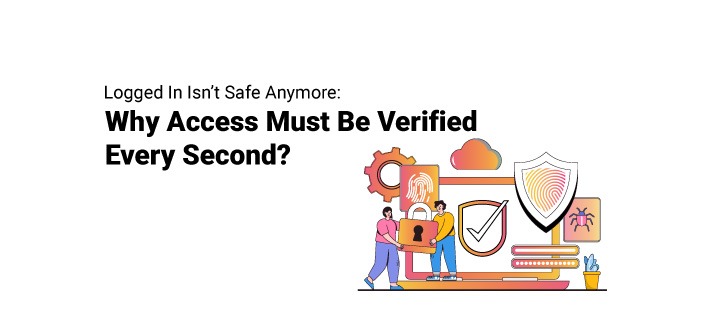
Logged In Isn’t Safe Anymore: Why Access Must Be Verified Every Second?
There was a time when logging in felt like crossing a finish line; once you were in, you were trusted.
Enter your credentials once, and the system assumes everything after that is safe. But in today’s digital world, that assumption is no longer just outdated; it’s outrageously dangerous.
Cyber attackers have changed the game. They don’t always break in anymore; they log in. By stealing credentials or hijacking active sessions, they can move through systems unnoticed, acting like legitimate users.
The reality is simple: being logged in no longer means being secure.
Security is no longer about guarding the front door; it’s about constantly verifying what’s happening inside.
The Problem with “Login Once, Trust Always”
Traditional access systems follow a simple model:
Authenticate once → grant access → trust the user until logout
This worked in a time when systems were limited, and threats were less sophisticated. But today, with cloud platforms, remote work, and multiple devices, this model creates a critical gap.
Imagine this:
An employee logs in at 9 AM from their office laptop. Everything seems normal.
At 11 AM, an attacker takes over that session through malware, phishing, or a stolen session token.
The system doesn’t question it.
It doesn’t recheck the user.
It simply trusts the session.
And just like that, the attacker gains full access without ever needing to log in.
This is known as (session hijacking), and it’s one of the fastest-growing attack methods today.
1. Why Modern Attacks Target Access, Not Entry?
Attackers today don’t think like hackers from the past.
They think like users.
Instead of forcing their way in, they:
- Use leaked or reused credentials
- Take over active sessions mid-way
- Operate within normal access patterns
Their goal is simple: look legitimate for as long as possible.
Because once they’re inside, the system rarely questions them again.
What makes this dangerous is not just access, it’s undetected activity.
Actions that appear normal on the surface can quietly turn into data exposure, misuse, or lateral movement across systems.
The real threat today isn’t getting in, it’s staying in without being noticed.
(The Shift to Continuous Authentication) :
To deal with this new reality, security is moving from a one-time check to an ongoing process:
Continuous Authentication
Access is no longer treated as a fixed state—it’s treated as something that can change at any moment.
Instead of asking “Was this user verified once?”
Systems now ask:
“Does this still look safe right now?”
This includes checking:
- Sudden changes in user behavior
- Unusual access patterns or timing
- Device trust and security posture
- Location shifts or impossible travel scenarios
Think of it less like a locked door and more like a system that’s constantly observing movement inside the building.
Trust is no longer permanent. It’s dynamic.
-
What Continuous Verification Looks Like Today?
Modern access control is becoming more context-aware and responsive.
Instead of static rules, systems now:
- Detect subtle behavior changes over time
- Identify risks based on context, not just credentials
- Trigger step-up authentication only when needed
- Limit access dynamically based on risk level
Like:-
- A user accessing files at an unusual hour → flagged
- Same account logging in from two distant locations → challenged
- Device showing signs of compromise → restricted instantly
Security becomes adaptive, not reactive.
-
Why This Matters for Businesses?
This shift is not just about security; it’s about control and confidence.
Organizations that adopt continuous verification can:
- Reduce the impact of compromised accounts
- Detect threats in real time
- Protect critical business data
- Enable secure remote and hybrid work
In a world where access is everywhere,
Trust must be continuously earned, not assumed once.
The idea of “log in once and stay trusted” belongs to a different era.
Today, access is not a one-time decision; it’s an ongoing process.
Threats don’t stop at login, and neither should your security.
Because in modern cybersecurity, trust is temporary and verification must be constant.
Being logged in is no longer proof of safety. It’s just the beginning of the journey.
Network Techlab, in partnership with Skillmine Auth, doesn’t just secure logins; we secure everything that happens after.
In a world where access can change in seconds, we help you move from static trust to real-time, continuously verified access control so every user, every action, and every moment is accounted for.
Because the real risk isn’t who logs in, it’s who stays unnoticed.
Ready to turn access into your strongest security layer instead of your weakest link?
Connect with Network Techlab and start building security that thinks beyond login.