
Active LED vs Video Wall: Key Differences for Modern Display Solutions
As organizations continue to embrace digital transformation, the need for impactful visual communication has never been greater. From corporate boardrooms and retail stores to control rooms and auditoriums, businesses rely on large-format displays to share information, engage audiences, and enhance collaboration. Among the most popular display technologies available today are Active LED Displays and Video Walls.
Although both solutions are designed to deliver large-scale visuals, they differ significantly in terms of technology, performance, installation, and overall user experience. Understanding these differences is essential for making the right investment. This article provides a detailed comparison of Active LED Displays and Video Walls, helping organizations choose the most suitable solution based on their operational and visual requirements.
What is an Active LED Display?
An Active LED Display is a display technology that uses thousands of tiny Light Emitting Diodes (LEDs) to create images directly on the screen. Unlike traditional LCD displays, Active LED screens do not require a separate backlight because each LED generates its own light. This enables the display to achieve superior brightness, deeper contrast levels, and vibrant color reproduction.
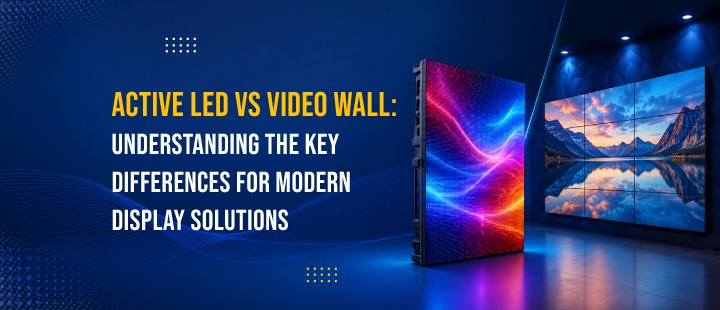
Active LED displays are built using modular LED cabinets that can be assembled into virtually any size or shape. Since there are no visible borders between modules, the result is a seamless visual canvas capable of delivering an immersive viewing experience. This makes Active LED technology particularly suitable for corporate lobbies, experience centers, auditoriums, retail environments, command centers, and large-scale digital signage applications.
The flexibility, scalability, and visual quality offered by Active LED displays have made them increasingly popular among organizations seeking modern and future-ready display solutions.
What is a Video Wall?
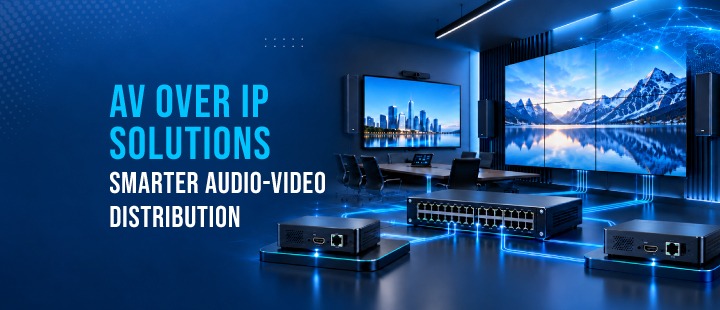
A Video Wall is a large display system created by combining multiple LCD or LED panels into a single visual surface. Each panel functions independently, while a video wall controller distributes content across all screens to create one unified image.
Video walls are commonly deployed in control rooms, security monitoring centers, educational institutions, transportation hubs, and corporate environments where large amounts of information need to be displayed simultaneously. They are especially effective for applications that require multiple content windows, dashboards, surveillance feeds, or data visualization.
While video walls provide a cost-effective way to achieve large display sizes, the bezels or borders around individual panels remain visible. Although modern ultra-narrow bezel displays minimize these gaps, they cannot completely eliminate them, which can affect the viewing experience for certain applications.
Technology Comparison
The fundamental difference between Active LED Displays and Video Walls lies in their display technology. Active LED displays use self-emitting LEDs to generate images directly, whereas video walls rely on individual LCD panels illuminated by a backlight system.
Because Active LED displays do not require panel borders, they provide a completely seamless image. Video walls, on the other hand, consist of multiple screens joined together, resulting in visible bezel lines between panels. For applications where visual continuity and aesthetics are critical, Active LED technology generally offers a superior viewing experience.
Furthermore, Active LED displays can achieve significantly higher brightness levels than video walls. This makes them ideal for environments with strong ambient lighting, such as retail showrooms, corporate lobbies, and public spaces.
Visual Quality and Viewing Experience
When it comes to visual performance, Active LED displays offer several advantages. The technology delivers exceptional brightness, high contrast ratios, rich colors, and wide viewing angles. These characteristics ensure that content remains clear and engaging even when viewed from different positions within a room.
Another major benefit is the absence of bezels. Whether displaying presentations, videos, graphics, or digital signage content, the image appears as one continuous screen without interruptions. This creates a more immersive and premium viewing experience.
Video walls also provide excellent image quality and high resolution, particularly for monitoring and data visualization applications. However, the bezel lines between panels can become noticeable when displaying full-screen images, videos, or presentations. For surveillance and operational monitoring, this is often acceptable, but for branding and audience engagement purposes, it may be less desirable.
Installation and Scalability
One of the biggest strengths of Active LED technology is its scalability. LED modules can be combined to create displays of virtually any size, aspect ratio, or shape. Whether an organization requires a small meeting room display or a massive auditorium screen, Active LED systems can be customized accordingly.
Additionally, curved and creative display designs are possible with LED technology, allowing businesses to create visually striking installations that stand out.
Video walls also offer flexibility in terms of screen size, but they are limited by the dimensions and arrangement of individual panels. Expanding a video wall often requires additional displays and careful configuration to maintain alignment and performance.
For organizations seeking highly customized visual environments, Active LED displays provide greater design freedom and scalability.
Maintenance and Reliability
Maintenance is an important consideration when investing in display technology. Modern Active LED displays are designed with front-serviceable modules, allowing technicians to replace individual LED modules quickly without dismantling the entire display structure. This reduces downtime and simplifies maintenance procedures.
Video walls require maintenance at the panel level. If a display panel experiences issues, the affected unit may need to be removed, replaced, or recalibrated. Over time, slight differences in brightness and color between panels can also occur, potentially impacting display uniformity.
Because Active LED displays consist of modular components, they often provide greater operational flexibility and easier long-term maintenance.
Cost Considerations
Budget plays a significant role in selecting the right display solution. Video walls generally have a lower upfront investment compared to Active LED displays, making them an attractive option for organizations with cost-sensitive projects.
For monitoring applications such as security operations centers and network operation centers, video walls often provide excellent value while meeting functional requirements.
Active LED displays typically involve a higher initial investment due to the advanced technology and seamless design. However, they deliver a premium visual experience, enhanced scalability, and long-term value. Organizations focused on customer engagement, brand image, and high-impact visual communication often find the investment worthwhile.
Rather than viewing cost alone as the deciding factor, businesses should consider the total value delivered throughout the display’s lifecycle.
Applications: Where Each Technology Excels
Active LED displays are best suited for environments where visual impact is critical. Corporate experience centers, executive briefing rooms, auditoriums, retail showrooms, hospitality venues, and event spaces frequently utilize LED technology to create engaging and memorable experiences.
Video walls excel in monitoring and operational environments. Security control rooms, network operation centers, transportation facilities, educational institutions, and command centers benefit from the ability to display multiple information sources simultaneously across a large visual surface.
The choice ultimately depends on the primary objective of the display—whether it is audience engagement or operational monitoring.
Active LED vs Video Wall: Quick Comparison
| Feature | Active LED Display | Video Wall |
| Display Type | Self-emitting LEDs | Multiple LCD Panels |
| Bezels | Seamless | Visible Bezels |
| Brightness | Very High | Moderate |
| Viewing Experience | Immersive | Functional |
| Scalability | Virtually Unlimited | Panel Dependent |
| Maintenance | Modular Replacement | Panel Replacement |
| Custom Shapes | Supported | Limited |
| Outdoor Usage | Suitable | Mostly Indoor |
| Initial Investment | Higher | Lower |
| Best Use Cases | Experience Centers, Retail, Auditoriums | Control Rooms, Monitoring Centers |
Both Active LED Displays and Video Walls are powerful display solutions capable of transforming how organizations communicate and share information. The right choice depends on your specific objectives, budget, environment, and audience expectations.
If your goal is to deliver a seamless, visually stunning, and future-ready display experience, Active LED technology is the ideal solution. Its superior brightness, scalability, and bezel-free design make it a preferred choice for customer-facing and high-impact applications.
On the other hand, if your primary requirement is operational monitoring, surveillance, or data visualization at a cost-effective price point, a Video Wall remains an excellent option.
Before making a decision, businesses should carefully evaluate their display requirements, viewing distances, content types, and long-term growth plans. Investing in the right display technology today can significantly enhance collaboration, communication, and customer engagement for years to come.
To learn more, feel free to contact Network Techlab especially when your goal is to get your hands on bespoke assessments. For more information feel free to share your feedback or service-related questions by calling +91 8879004536 or sending an email to info@netlabindia.com.