
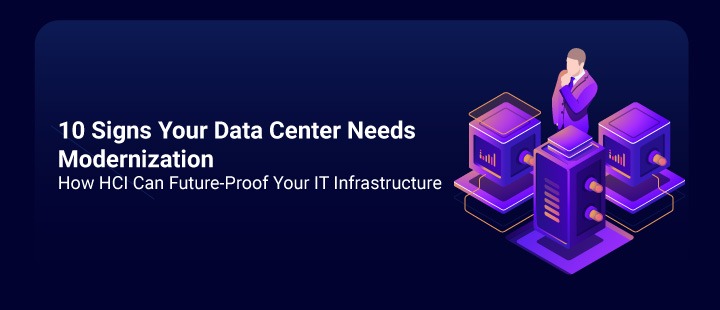
10 Signs Your Data Center Needs Modernization & How HCI Can Future-Proof IT Infra
In today’s digital-first business environment, your data center is more than just an IT asset—it is the backbone of operations, innovation, and growth. As organizations embrace cloud computing, AI-driven applications, cybersecurity initiatives, and hybrid work models, legacy infrastructure is struggling to keep pace.
Many businesses continue to invest time and resources into maintaining aging systems, often unaware that these environments are limiting performance, increasing costs, and exposing the organization to operational risks.
If you’re wondering whether it’s time to modernize your data center, here are ten clear signs to watch for—and why Hyper-Converged Infrastructure (HCI) is becoming a preferred modernization strategy.
1. Managing Infrastructure Feels Increasingly Complex
Traditional data centers typically operate across multiple platforms for compute, storage, networking, virtualization, backup, and security. Managing these siloed environments often requires specialized expertise and multiple management consoles.
Why This Matters
Complexity increases operational overhead, slows troubleshooting, and consumes valuable IT resources.
How HCI Helps
HCI combines compute, storage, and virtualization into a unified software-defined platform, simplifying infrastructure management and reducing administrative burden.
2. Infrastructure Scaling Takes Weeks or Months
Business growth often demands additional computing resources. In traditional environments, scaling infrastructure can involve extensive planning, procurement, deployment, and integration efforts.
Why This Matters
Slow scalability can delay projects, impact user experience, and hinder business agility.
How HCI Helps
HCI enables organizations to scale incrementally by adding nodes as needed, allowing faster expansion without major infrastructure redesign.
3. Rising Operational Costs Are Affecting IT Budgets
Escalating expenses related to power, cooling, maintenance contracts, hardware upgrades, and data center space can significantly increase the total cost of ownership.
Why This Matters
Budget constraints often force organizations to delay critical IT initiatives.
How HCI Helps
By consolidating infrastructure components and improving resource utilization, HCI helps reduce operational costs while maximizing efficiency.
4. Application Performance Is Becoming Inconsistent
Slow applications, storage bottlenecks, and resource contention are common challenges in aging environments.
Why This Matters
Poor performance impacts employee productivity, customer experience, and business operations.
How HCI Helps
HCI distributes workloads across clustered resources, delivering improved performance, better workload balancing, and greater reliability.
5. Disaster Recovery Is Complicated and Expensive
Many organizations rely on separate backup, replication, and recovery systems that are difficult to manage and maintain.
Why This Matters
Long recovery times can lead to significant financial and operational losses during outages.
How HCI Helps
Modern HCI platforms often include integrated disaster recovery and data protection capabilities, helping organizations improve business continuity while reducing complexity.
6. Hardware Refresh Cycles Are Becoming More Frequent
If infrastructure components require constant upgrades or replacements, maintaining the environment can become costly and disruptive.
Why This Matters
Frequent refresh cycles consume budget and divert IT teams from strategic initiatives.
How HCI Helps
HCI provides a scalable and modular architecture that simplifies upgrades and supports long-term infrastructure growth.
7. Supporting New Business Applications Is Challenging
Emerging technologies such as artificial intelligence, machine learning, analytics, and cloud-native applications place greater demands on infrastructure.
Why This Matters
Legacy systems may not provide the flexibility or performance required for modern workloads.
How HCI Helps
HCI delivers a flexible and scalable foundation capable of supporting evolving business requirements and next-generation applications.
8. Security and Compliance Demands Are Increasing
Cybersecurity threats and regulatory requirements continue to grow across industries.
Why This Matters
Older infrastructure may lack the visibility, automation, and resilience needed to address modern security challenges.
How HCI Helps
Many HCI solutions incorporate advanced security features, encryption, role-based access controls, and automated recovery mechanisms to strengthen cyber resilience.
9. Cloud Integration Feels Difficult
Organizations increasingly adopt hybrid cloud strategies, yet many legacy environments struggle to integrate effectively with public cloud platforms.
Why This Matters
Poor integration limits flexibility and can increase operational complexity.
How HCI Helps
HCI serves as an ideal foundation for hybrid cloud environments by providing consistent management, scalability, and workload portability.
10. IT Teams Spend More Time Maintaining Than Innovating
When infrastructure management consumes the majority of IT resources, organizations lose valuable opportunities to focus on business transformation.
Why This Matters
Innovation slows when teams are constantly addressing infrastructure issues.
How HCI Helps
By automating routine operations and simplifying management, HCI allows IT teams to focus on strategic initiatives that drive business growth.
Why HCI Is at the Center of Data Center Modernization
Data center modernization is no longer just about replacing outdated hardware. It is about building an infrastructure that can adapt to changing business demands while improving efficiency, resilience, and scalability.
Hyper-Converged Infrastructure addresses many of the challenges associated with traditional architectures by offering:
- Simplified infrastructure management
- Faster scalability
- Reduced operational costs
- Improved disaster recovery
- Enhanced security and resilience
- Support for hybrid cloud initiatives
- Readiness for AI and modern workloads
As organizations continue their digital transformation journeys, HCI is emerging as a practical and future-ready approach to modernizing the data center.
Conclusion
Aging infrastructure can quietly impact business performance, increase operational costs, and limit an organization’s ability to innovate. As enterprises embrace AI, hybrid cloud, advanced security frameworks, and data-driven operations, the need for a modern, scalable, and resilient infrastructure becomes increasingly important.
Hyper-Converged Infrastructure (HCI) offers a practical path to modernization by simplifying operations, improving resource utilization, enhancing business continuity, and providing the flexibility needed to support future growth. Whether you’re looking to refresh your existing data center, reduce infrastructure complexity, or build a foundation for AI and cloud initiatives, HCI can help transform your IT environment into a strategic business enabler.
At Network Techlab India Ltd., we help organizations assess their current infrastructure, identify modernization opportunities, and design HCI solutions tailored to their business objectives. With over 30 years of experience in IT infrastructure, data center solutions, networking, cybersecurity, and managed services, our team works closely with enterprises to build secure, scalable, and future-ready environments that align with their digital transformation goals.
If you’re evaluating your next infrastructure upgrade, Network Techlab can help you develop a roadmap that minimizes complexity, maximizes performance, and prepares your organization for the demands of tomorrow.