
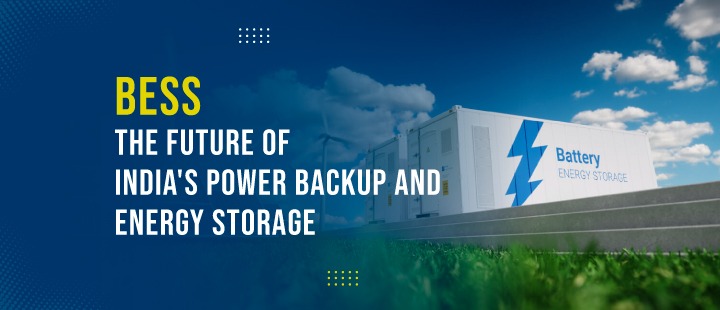
BESS – The Future of India’s Power Backup and Energy Storage
For decades, power backup in India has followed a familiar pattern.
When the grid fails, the UPS takes over for a few minutes, and if the outage continues, the diesel generator starts running. This approach has powered businesses, factories, hospitals, data centers, and commercial buildings for years.
But India’s energy landscape is changing rapidly.
Today, the conversation is no longer just about backup power. It is about energy independence, sustainability, cost optimization, and ensuring reliable power in a world increasingly powered by renewable energy.
At the center of this transformation is Battery Energy Storage System (BESS) technology.
What was once considered a niche technology is now becoming one of the most important pillars of India’s energy future.
A Silent Revolution Is Underway
Most people associate batteries with mobile phones, laptops, or electric vehicles.
However, modern Battery Energy Storage Systems operate on an entirely different scale.
These systems can store large amounts of electricity when power is available and release it when demand increases or supply becomes unstable.
Think of BESS as a giant energy bank.
Instead of allowing excess solar or wind energy to go unused, businesses and utilities can store that energy and use it exactly when required.
This simple concept is creating a revolution across the power sector.
As India continues to expand renewable energy capacity, energy storage is becoming essential for maintaining grid stability and ensuring uninterrupted power supply.
Why India Needs BESS More Than Ever
India is one of the fastest-growing energy markets in the world.
The country has set an ambitious target of achieving 500 GW of non-fossil fuel energy capacity by 2030. However, renewable energy sources such as solar and wind are naturally intermittent. Solar power generation drops after sunset, and wind generation depends on weather conditions. To bridge this gap, large-scale energy storage is becoming a necessity rather than an option. The Government of India has already recognized BESS as a critical component of the country’s energy transition. According to the Ministry of Power, over 35.8 GWh of battery storage capacity is currently under construction across India.
This is a clear indication that energy storage is moving from planning to deployment.
The Shift from Diesel to Batteries
One of the biggest changes happening today is the gradual shift away from diesel-based backup systems.
Diesel generators have served businesses for years, but they come with several challenges:
- Rising fuel costs
- High maintenance requirements
- Carbon emissions
- Noise pollution
- Regulatory compliance issues
Battery Energy Storage Systems offer a cleaner and smarter alternative.
Unlike diesel generators, BESS systems operate silently, require minimal maintenance, and can seamlessly integrate with solar power installations.
For organizations looking to reduce operational costs and achieve sustainability goals, this shift is becoming increasingly attractive.
India’s Energy Storage Boom Has Already Started
Just weeks ago, Adani Green commissioned a 3.37 GWh Battery Energy Storage System at its Khavda renewable energy project in Gujarat, one of the largest renewable energy hubs in the country.
In another major development, Adani Green announced plans to commission up to 14 GWh of battery storage capacity at Khavda to reduce renewable energy wastage and improve grid utilization.
The momentum isn’t limited to one company.
Avaada Group recently announced plans for large-scale battery manufacturing and energy storage expansion, targeting 17,000 MW of battery storage capacity across India.
Even global players are paying attention. Tesla has started preparing its entry into India’s utility-scale energy storage market, signaling strong confidence in the country’s future demand for battery storage solutions.
These are not pilot projects anymore.
They are investments worth billions of dollars aimed at building India’s next-generation energy infrastructure.
More Than Backup Power
The biggest misconception about BESS is that it only serves as a backup power solution.
In reality, modern Battery Energy Storage Systems deliver far more value.
They help organizations:
- Reduce electricity costs during peak tariff hours
- Improve renewable energy utilization
- Stabilize power quality
- Reduce dependence on diesel generators
- Support critical operations during outages
- Optimize energy consumption patterns
For industries with high energy usage, BESS is increasingly becoming an energy management tool rather than just a backup solution.
The Future of Data Centers, Manufacturing, and Commercial Buildings
As India continues to digitize, industries such as data centers, manufacturing plants, hospitals, airports, and commercial campuses require reliable power around the clock.
Even a few seconds of downtime can result in significant financial losses.
Battery Energy Storage Systems provide a faster, cleaner, and more efficient way to maintain power continuity.
This is one of the reasons why data centers and critical infrastructure projects are increasingly evaluating BESS as part of their long-term energy strategy.
The future isn’t simply about keeping the lights on.
It’s about creating resilient infrastructure that can operate efficiently regardless of grid conditions.
India’s Ambitious Storage Targets
The scale of India’s energy storage ambitions is remarkable.
According to government projections, India is targeting approximately 74 GW of Battery Energy Storage System capacity by 2031-32 to support renewable energy growth and ensure reliable power delivery.
Industry estimates also suggest that India will require hundreds of gigawatt-hours of energy storage over the coming decade to support renewable integration and grid stability.
These numbers highlight one important reality:
Energy storage is no longer a supporting technology.
It is becoming a core component of India’s energy infrastructure.
How Network Techlab Supports the Energy Transition
At Network Techlab, we believe the future of power backup goes beyond conventional UPS and diesel generator solutions.
As organizations move toward sustainable and intelligent energy infrastructure, Battery Energy Storage Systems are becoming a key part of that journey.
Our energy solutions help businesses evaluate, design, and implement modern power backup and energy storage strategies that improve reliability, reduce operating costs, and support long-term sustainability goals.
Whether integrated with solar power systems, critical facility infrastructure, or enterprise backup environments, BESS enables organizations to build a smarter and more resilient energy ecosystem.
India is standing at the beginning of a major energy revolution.
Just as solar transformed the way electricity is generated, Battery Energy Storage Systems are transforming the way electricity is stored, managed, and consumed.
The question is no longer whether BESS will become mainstream.
The real question is how quickly businesses, industries, and utilities will adopt it.
As renewable energy adoption accelerates and energy security becomes increasingly important, Battery Energy Storage Systems will play a defining role in shaping India’s power future.
The future of power backup isn’t louder generators or larger fuel tanks.
The future is smarter, cleaner, quieter, and it’s powered by BESS.
To learn more, feel free to contact Network Techlab especially when your goal is to get your hands on bespoke assessments. For more information feel free to share your feedback or service-related questions by calling +91 8879004536 or sending an email to info@netlabindia.com.