
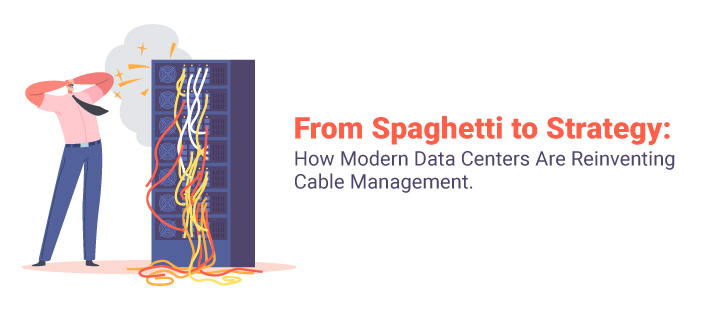
From Spaghetti to Strategy: How Modern Data Centers Are Reinventing Cable Management
Behind every seamless app, instant transaction, and real-time experience… there’s a part no one talks about.
Not the servers. Not the cloud.
The cables.
Step into a traditional data centre, and you won’t just see infrastructure—you’ll see confusion. Thick bundles of cables twisted together, unlabeled connections, and pathways that only a few “experts” understand. It’s not just messy—it’s risky.
One wrong move, one unplugged cable, and suddenly—systems go down, operations halt, and businesses lose time and money.
What looks like a minor inconvenience is actually a silent threat hiding in plain sight.
Today, data centres are no longer just storage rooms for servers—they are the backbone of digital businesses. And to keep up with rising data demands, faster speeds, and constant uptime, cable management has evolved from messy improvisation to strategic design.
This shift isn’t just an upgrade; it’s a complete transformation.
1. The “Before”: When Cabling Was Chaos
Traditional data centres relied heavily on point-to-point cabling, where each device was directly connected to another. Over time, as systems expanded, this created a tangled web of cables commonly known as “spaghetti cabling.”
Challenges of old setups:
- Difficult to identify and trace cables
- High risk of human error (disconnecting the wrong cable)
- Poor airflow leading to overheating
- Increased downtime and maintenance time
- No scalability for future growth
This kind of setup not only slowed operations but also increased operational costs and complexity.
2. The “After” Structured Cabling Brings Order.
Modern data centres have shifted to structured cabling systems, a standardized, organized approach that connects everything through a central distribution framework.
Instead of chaos, you get clarity.
Key advantages:
- Clean, organized layout with labeled connections
- Faster troubleshooting and maintenance
- Improved airflow and equipment lifespan
- Easier upgrades and scalability
- Reduced downtime and operational costs
Structured cabling acts like a well-planned highway system—ensuring smooth, efficient data flow instead of traffic jams.
3. The Transformation: Old vs Modern Cabling
| Aspect | Old (Messy Setup) | Modern (Structured Cabling) |
| Layout | Tangled & unorganized | Clean & standardized |
| Maintenance | Time-consuming | Quick & efficient |
| Scalability | Difficult | Easy to expand |
| Airflow | Blocked | Optimized |
| Error Risk | High | Minimal |
This shift is not just visual; it directly impacts performance, uptime, and business continuity.
4. New Trends Reinventing Cable Management
Modern data centre cabling is not stopping at the organization. It’s becoming smarter, faster, and more intelligent.
🔹 1. Modular Cabling
- Uses patch panels and modular components
- Changes can be made without disturbing the entire system
- Supports rapid scaling and upgrades
Modular designs isolate changes and protect core infrastructure, making operations more flexible.
🔹 2. Color Coding & Labeling
- Different cable types are color-coded
- Easy identification reduces troubleshooting time
- Minimizes human errors
This simple strategy dramatically improves visibility and operational efficiency.
🔹 3. Automation & AI-Driven Cabling
- Tracks connections in real time
- Detects errors like mispatching instantly
- Predicts failures before they happen
With increasing complexity, manual management is no longer sustainable—automation ensures accuracy and speed.
🔹 4. Smart Monitoring Systems
- Sensors monitor cable health, temperature, and performance
- AI detects anomalies early
- Enables proactive maintenance
This shift turns cabling from a passive component into an intelligent system.
5. Why This Transformation Matters
Modern businesses depend on speed, uptime, and scalability. Poor cabling can silently damage all three.
Structured and intelligent cabling:
- Reduces downtime risks
- Improves network performance
- Supports high-speed technologies (like 400G/800G networks)
- Future-proofs the infrastructure
In short, cable management is no longer just “wiring”; it’s a strategic asset