
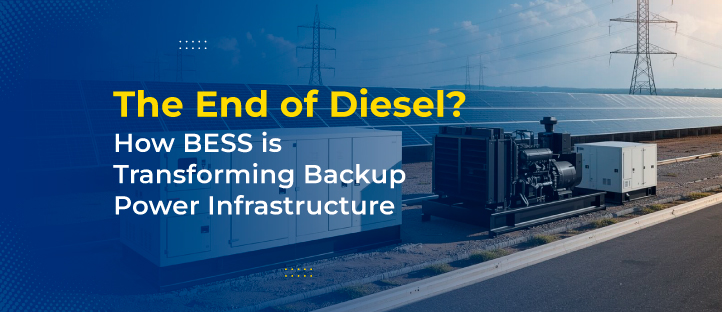
The End of Diesel? How BESS is Transforming Backup Power Infrastructure
For decades, the hum of a diesel generator kicking in during a power outage was the sound of reliability. From hospitals and data centres to factories and commercial buildings, the diesel generator set or DG set has been the unchallenged backbone of backup power infrastructure across the world. But that era is quietly beginning to shift. Battery Energy Storage Systems, or BESS, are rapidly emerging as a cleaner, smarter, and increasingly cost-competitive alternative for short-duration backup needs and the energy industry is paying close attention. That said, this is not a simple overnight replacement story. It is a gradual, strategic transition driven by environmental urgency, economics, and evolving technology.
The Diesel Legacy: Proven but Problematic
There is no denying that diesel generators earned their place. They are robust, familiar, scalable from kilowatts to multi-megawatts, and most importantly capable of running continuously for as long as fuel is available. For remote sites, extended outages, and multi-day emergencies, diesel remains unmatched in endurance. A 2 MW diesel generator with a 10,000-gallon fuel tank can deliver over 72 hours of continuous runtime. No current BESS installation at comparable cost can match that duration. This is a reality the industry must acknowledge honestly.
However, the operational and environmental costs of diesel are becoming increasingly difficult to justify. Diesel generators emit carbon dioxide, nitrogen oxides, and particulate matter all of which contribute to air pollution and greenhouse gas accumulation. Beyond the environmental damage, the operational challenges are mounting. Diesel requires regular maintenance including oil changes, fuel replenishment, load bank testing, and mechanical servicing, all of which add cost and complexity. Diesel fuel, being a globally traded commodity, is also subject to price volatility, creating unpredictable energy expenses for businesses planning long-term budgets.
Perhaps most critically for modern digital infrastructure, the response time of a diesel generator is a fundamental shortcoming. It can take anywhere from 10 to 20 seconds for a generator to start up and reach full operational capacity a delay that can be catastrophic for hospitals, financial institutions, and AI-driven data centres where milliseconds of power interruption can corrupt processes and cost millions.
Enter BESS: A New Paradigm for Short-Duration Backup
Battery Energy Storage Systems operate on an entirely different principle. Rather than burning fuel to produce electricity, BESS stores energy from the grid or renewable sources such as solar and discharges it on demand. This fundamental difference unlocks a range of performance advantages that diesel simply cannot replicate particularly for short-duration, high-precision power requirements.
BESS are fast, virtually maintenance-free, and environmentally clean. They require no fuel storage, generate no exhaust, operate silently, and can last more than 20 years with proper management. On the question of response time, the contrast with diesel is dramatic. BESS responds in 300 to 500 milliseconds at the inverter switching level, and UPS-integrated battery systems can respond in under 10 milliseconds. For AI-driven data centres where power demand can spike in milliseconds due to training and inference workloads, this sub-second response is non-negotiable.
However, it is important to be transparent about BESS’s primary limitation: backup duration. Current BESS designs typically provide backup power for no more than four hours before requiring recharging. For businesses experiencing the majority of their outages which statistically last under two hours this is entirely sufficient. But for operations requiring multi-day resilience, BESS alone is not yet the answer. This distinction is central to understanding where BESS fits, and where diesel still holds relevance.
DG Sets vs. BESS: A Head-to-Head Comparison
To understand why the industry is shifting and where it is not it helps to compare both technologies honestly across the metrics that matter most.
Response Time: BESS responds in milliseconds. Diesel generators take 10 to 20 seconds to reach full capacity. For hospitals, data centres, and financial institutions, BESS wins decisively on this parameter.
Backup Duration: This is where diesel dominates. A diesel generator runs as long as fuel is available hours, days, or longer. BESS typically delivers 2 to 4 hours of backup on current standard designs. For routine outages, BESS is sufficient. For catastrophic or multi-day events, diesel remains critical.
Emissions: BESS generates zero on-site CO₂ emissions during operation, compared to diesel generators that can emit 67.32 tons of CO₂ annually in comparable applications. When charged from solar or wind energy, BESS achieves a completely clean operational footprint.
Cost Over Time: The total 20-year cost of BESS has been found to be comparable to and increasingly lower than diesel in real-world microgrid studies. For the Indian market, the comparison is striking the cost of power generation with a DG set is currently around INR 29.07 per kWh, while lithium-ion battery storage delivers power at approximately INR 15.17 per kWh. Industry experts have further noted that pairing BESS with solar can save businesses INR 10 to INR 15 per kWh compared to diesel genset operation.
Noise: BESS systems emit around 70 to 75 decibels comparable to a vacuum cleaner far below the noise levels of diesel generators, making them significantly more acceptable in urban and commercial environments.
Maintenance: Diesel demands routine oil changes, fuel logistics, cooling system checks, and mechanical servicing. BESS has no combustion components, no moving parts in its storage cells, and dramatically lower maintenance overhead.
Space: This is an emerging concern for BESS at scale. A 2 MW BESS designed to match the long-duration runtime of a diesel system would require approximately 81 battery containers occupying the footprint of nearly half a football field. Diesel’s compact footprint remains a genuine advantage for space-constrained facilities.
Carbon Credits: Every megawatt-hour discharged from BESS translates to approximately 0.76 tonnes of CO₂e reduction using EPA eGRID methodology, with trading values of $85 to $150 per metric ton on markets such as the EU ETS. Diesel generators generate no such value they are a liability in carbon accounting, not an asset.
Carbon Credits: The Hidden Financial Advantage of BESS
This is where the economics of BESS get genuinely compelling, and where many decision-makers have yet to fully calculate the opportunity. Every kilowatt-hour of clean energy discharged by a BESS instead of combusted by a diesel generator represents a measurable, monetisable reduction in greenhouse gas emissions. These reductions can be converted into carbon credits and traded on regulated and voluntary carbon markets, generating real revenue for businesses that make the switch.
Emerging carbon markets unlock new BESS revenue streams through carbon credit monetisation. Operational models include Emission Reduction Certificates where discharging one MWh from BESS results in a 0.76 tCO₂e reduction, and qualifying for carbon credit multipliers under programmes like California’s AB 2627 by shifting 70% of charging load to renewable energy hours.
In India, this opportunity is becoming structurally significant. India’s Carbon Credit Trading Scheme (CCTS) is advancing rapidly, with the Ministry of Power approving eight crediting methodologies in March 2025, including renewable energy with storage making BESS projects directly eligible to generate Carbon Credit Certificates (CCCs). India’s Carbon Credit Trading Scheme is set to begin compliance in 2026, covering nine industrial sectors and placing India among the world’s largest emissions trading systems.
For businesses currently running diesel gensets, this creates a powerful financial case. Every hour that a DG set runs, it accumulates carbon liability. Every hour that BESS operates in its place, it can accumulate carbon credit value. Carbon price analysts expect rates of ₹600 to ₹1,200 per tonne in Phase 1 of India’s carbon market and early movers who reduce emissions or mint high-integrity credits stand to lock in low-cost advantages before the scheme tightens post-2030.
Businesses that replace or supplement their DG sets with BESS today are not merely saving on fuel costs they are positioning themselves to earn carbon credits, improve their ESG ratings, satisfy investor sustainability requirements, and avoid future carbon penalties as regulation tightens.
Real-World Deployments Driving the Shift
The transition is no longer theoretical. It is happening at scale across industries and geographies.
Microsoft is leading the data centre industry’s move away from diesel. Saft, a subsidiary of TotalEnergies, delivered a BESS to replace diesel backup power generators at Microsoft’s sustainable data centre in Sweden, with the system entering operation in June 2023. The system provides four groups of 4 MWh each for up to 80 minutes of backup energy, and also supports grid stability with black start capability. Microsoft’s General Manager for Cloud Operations stated that finding diesel alternatives is integral not just to its 2030 carbon-negative goal but to its commitment to remove all carbon emitted since the company’s founding in 1975.
National Grid and Tesla demonstrated BESS viability at the community scale. On the island of Nantucket, National Grid installed a 6 MW BESS offering 48 MWh of power to reduce reliance on expensive diesel backup generators, also helping reduce peak demand and stabilise the grid.
In remote heavy industry, remote mines in Australia and Africa now operate with solar and BESS microgrids, reducing diesel reliance by up to 80%, with applications extending to offshore oil and gas facilities, manufacturing parks, and ports and logistics hubs.
In India, the momentum is building with policy backing. Grid India’s Short-Term Resource Adequacy Plan for 2025-26 projects a requirement of 4 GW and 17 GWh of BESS, and the government extended Inter-State Transmission System waivers for solar and BESS projects up to 2028 positioning 2025 as a watershed year for large-scale energy storage deployment. India’s Union Budget 2026-27 included Viability Gap Funding for BESS and customs duty exemptions on lithium-ion battery manufacturing inputs, signalling strong government intent to accelerate adoption.
The Hybrid Bridge: The Smart Transition Strategy
For the vast majority of facilities that cannot yet afford to abandon diesel entirely particularly those needing extended backup for critical operations the hybrid approach represents the most pragmatic and financially intelligent path forward.
In a hybrid configuration, BESS handles all short-duration outages instantaneously and cleanly, while the diesel generator is reserved strictly for extended, multi-hour events. By anticipating an outage lasting more than two hours, a hybrid configuration can be engaged using traditional diesel or natural gas generators early enough to recharge the BESS, extending the four-hour window to perhaps eight hours or more, covering an even greater percentage of annual outages.
This arrangement is transformative in its impact on diesel consumption. When a DG set is only activated for true extended emergencies rather than every grid fluctuation or short interruption, fuel consumption, maintenance cycles, service intervals, and emissions all fall dramatically. The carbon credit benefit begins to accrue even before a full diesel replacement is achieved. In remote oil and gas operations, BESS can store excess energy and provide backup power while reducing generator run-time, improving fuel efficiency, and extending equipment life by reducing start/stop cycles.
The hybrid model also de-risks the technology transition. Organisations can gain operational experience with BESS, build internal confidence, and progressively expand battery capacity as costs decline and battery durations improve all without ever compromising their backup power guarantee.
Regulatory Pressure: The Accelerating Tailwind
Regulation is increasingly making the cost of staying with diesel higher, while simultaneously reducing the cost of switching to BESS. Emissions penalties in Boston, Cambridge, New York, and California are making diesel generator installations progressively more difficult and expensive, and similar policy trajectories are unfolding across Europe, Australia, and Asia.
In India, urban air quality has become a political flashpoint. Delhi-NCR and neighbouring regions continue to record hazardous air quality levels, and the Central Pollution Control Board has intensified scrutiny on diesel emissions from commercial and industrial sources. While regulatory frameworks are still maturing, the direction is unmistakable operating diesel in pollution-sensitive urban environments will attract increasing scrutiny, restriction, and eventually penalty.
On the financial side, the cost trajectory of batteries continues to improve the investment case for BESS dramatically. Lithium carbonate prices fell 67% year-on-year in early 2024, directly reducing BESS capital costs. According to the US Energy Information Administration, 10.3 gigawatts of utility-scale BESS were installed in 2024, with forecasts projecting more than 18 gigawatts to be built by end of 2025 about 80% more than 2024. This explosive deployment is driving further cost reductions through manufacturing scale and supply chain maturity.
What the Future Looks Like
The future of backup power is not a binary choice between diesel and batteries it is a layered, intelligent architecture that uses each technology for what it does best. BESS will handle the vast majority of outages the short, sharp disruptions that dominate the statistics silently, instantly, and cleanly. Diesel will remain in the architecture as the last-resort extended-duration backstop for truly exceptional events, operated far less frequently and therefore far more efficiently.
Over time, as battery energy density improves, discharge durations extend, and carbon credit revenues make the financial case increasingly compelling, diesel’s role will shrink further. Solid-state batteries promise double the energy density of current lithium-ion. Iron-air and zinc-air chemistries are targeting discharge durations exceeding 100 hours. Flow batteries offer long lifespans suited to industrial applications. California Community Power’s first eight-hour long-duration lithium-ion BESS project with a 69 MW output and 552 MWh capacity is already operational by 2026, pointing to where the technology is heading.
India has set a target of 47 GW of battery storage by 2032 to support renewable energy integration, and the policy infrastructure from Viability Gap Funding to carbon credit methodologies to transmission charge waivers is increasingly designed to make BESS the default choice for new installations.
Conclusion: A Gradual, Inevitable Transition
The end of diesel is not an event it is a process. And it is a process that is well underway. For facility managers, energy directors, and business owners, the question is no longer whether to evaluate BESS, but how to sequence the transition intelligently.
For new installations in urban, pollution-sensitive, or ESG-driven environments, BESS is already the right choice for short-duration backup cleaner, faster, quieter, and increasingly cheaper than diesel. For existing facilities with diesel infrastructure, a hybrid approach immediately reduces emissions, cuts operational costs, and begins generating carbon credit value without sacrificing backup reliability.
Diesel served the world well for over a century. Its endurance advantage means it will not disappear overnight and for remote, rural, and extended-duration applications, it will remain relevant for years to come. But where pollution matters, where carbon credits create financial incentive, where urban regulations tighten, and where millisecond response times are critical, BESS has already won the argument. The transition has begun and it runs on intelligence, not combustion.