
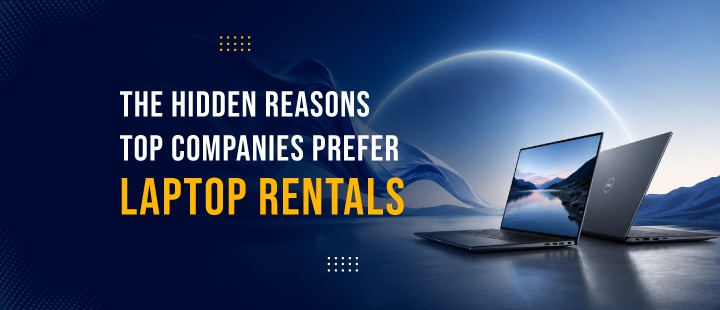
The Hidden Reasons Top Companies Prefer Laptop Rentals
A few years ago, if you walked into the office of a large multinational company, you’d probably find rows of company-owned laptops purchased in bulk and managed internally by the IT team.
Today, that picture is changing.
More enterprises are moving toward flexible IT models where laptops are rented instead of purchased outright. While many people assume this is purely about saving money, the reality is far more interesting.
The biggest reason isn’t cost.
It’s flexibility.
In a business environment where companies are constantly hiring, scaling teams, launching projects, and adapting to changing market conditions, owning thousands of devices isn’t always the smartest option.
The New Reality of Enterprise IT
Think about how businesses operate today compared to five years ago.
Teams are no longer confined to a single office. Employees work from different cities, states, and even countries. Contractors, consultants, project teams, and temporary employees have become a normal part of the workforce.
A recent study on hybrid work highlighted that organizations continue to adopt flexible work models because there is no one-size-fits-all approach to where and how employees work. Businesses are constantly adjusting workforce structures based on project and operational needs.
This creates a challenge for IT teams.
How do you quickly provide secure, standardized devices to employees when workforce requirements can change every month?
The answer for many organizations is laptop rental.
Speed Has Become More Important Than Ownership
Imagine a company wins a large project and suddenly needs 200 laptops within a week.
Traditional procurement involves approvals, vendor negotiations, purchasing, shipping, imaging, configuration, and deployment.
That process can take weeks.
Laptop rental providers can often deliver pre-configured devices within days, allowing employees to start work immediately. Businesses increasingly view speed as a competitive advantage, especially when onboarding new teams or launching short-term projects.
For many enterprises, waiting weeks for hardware is no longer acceptable.
The Shift from Capex to Opex
One of the biggest changes in corporate finance has been the move from large capital expenditures (CapEx) toward operational expenditures (OpEx).
Instead of spending crores on hardware that begins depreciating the day it is purchased, companies prefer predictable monthly operating expenses.
This approach improves cash flow and gives organizations greater financial flexibility. Industry analysts have noted that businesses increasingly prefer technology consumption models where they pay only for what they use rather than making large upfront investments.
For CFOs, this often makes much more sense than owning large fleets of devices.
Technology Becomes Outdated Faster Than Ever
The average business laptop purchased three years ago is very different from what employees need today.
Modern workloads involve cloud applications, video collaboration, AI tools, analytics platforms, and increasingly demanding software.
According to recent enterprise technology reports, organizations are placing greater emphasis on performance, longevity, AI-ready devices, security, and modern workplace experiences.
The problem with buying laptops outright is that businesses become responsible for refresh cycles, upgrades, asset disposal, and replacement planning.
With rental models, organizations can refresh technology more frequently without making another large investment.
Hybrid Work Changed Everything
The pandemic permanently changed workplace expectations.
Today, employees may work from home, client locations, branch offices, or corporate headquarters throughout the same month.
Providing devices to a distributed workforce creates significant logistical challenges.
Laptop rental services help enterprises ship devices directly to employees, recover them when projects end, and redeploy them where needed. This has become especially valuable for companies’ managing hybrid and remote teams.
In many cases, rental models simplify IT operations far more than maintaining large inventories of spare devices.
What Most People Don’t Realize: It’s About Risk
Every purchased laptop comes with hidden risks.
- Hardware failures
- Warranty management
- Asset tracking
- Device disposal
- Theft or loss
- Technology obsolescence
When companies rent laptops, much of this responsibility shifts to the service provider.
Maintenance, replacement support, device refreshes, and logistics are often included as part of the agreement. This allows internal IT teams to focus on strategic initiatives rather than hardware administration.
For large enterprises managing hundreds or thousands of devices, that operational relief can be substantial.
Even the Industry Is Moving Toward “Technology as a Service”
The trend isn’t limited to laptops.
Cloud computing replaced physical servers.
Software subscriptions replaced perpetual licenses.
Now hardware is following the same path.
Research cited by Gartner indicates that organizations are increasingly adopting consumption-based IT models such as Desktop-as-a-Service (DaaS), driven by cost efficiency, flexibility, and simplified management.
The message is clear:
Businesses increasingly want access to technology rather than ownership of technology.
How Network Techlab Supports Modern Enterprises
At Network Techlab, we’ve seen this shift firsthand across industries including IT services, BFSI, manufacturing, healthcare, education, event management, and startups.
Organizations today need laptops for:
- New employee onboarding
- Project-based teams
- Training programs
- Corporate events
- Temporary workforce expansion
- Remote and hybrid employees
- Software testing environments
Our laptop rental solutions help businesses deploy devices quickly without large capital investments. Whether the requirement is for a few days, a few months, or a long-term engagement, organizations can access enterprise-grade laptops with the flexibility modern business demands.
The objective is simple: give businesses the technology they need, exactly when they need it.
Final Thoughts
The biggest misconception about laptop rentals is that companies choose them only because they are cheaper.
In reality, top enterprises rent laptops because it gives them something even more valuable: agility.
The ability to scale up quickly, deploy technology faster, manage costs more effectively, and stay current with evolving workplace requirements has made laptop rentals a strategic business decision rather than just an IT purchase.
As workforces become more distributed and technology continues to evolve, the question is no longer “Why rent laptops?”
For many organizations, the better question is:
“Why own them at all?”
To learn more, feel free to contact Network Techlab especially when your goal is to get your hands on bespoke assessments. For more information feel free to share your feedback or service-related questions by calling +91 8879004536 or sending an email to info@netlabindia.com.